
2026 Alfred Russel Wallace Awardee

Mark Lomolino has made important contributions to island biogeography, especially to the concepts ‘habitat corridors’, ’small island effect’, and the species-area relationships. His dedicated support for The International Biogeography Society, including a profound role in the Society’s founding 25 years ago (around the year 2000), and his coauthoring of a foundational textbook of [...]

2026-01-06T09:04:37-05:00Categories: Awards, Featured, Misc posts, News|

2026 Alfred Russel Wallace Awardee

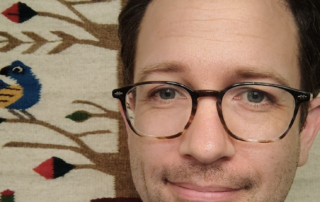
Michael Donoghue's conceptual creativity and impact in the field of biogeography, specifically his role in bringing “tree-thinking” to biogeography and in fostering connections between the phylogenetics community and researchers in historic biogeography, cannot overstated: His research and new ways of thinking have left an indelible legacy that has been carried forward by Michael’s [...]

2026-01-06T09:06:46-05:00Categories: Awards, Featured, Misc posts, News|

November 2025 Funk Biogeography Seminar — Laura Pollock

Mind the Wallacean Gap: What is our strategy for improving biogeographic data? What we don't know about biogeographic data is very well-known. Studies routinely demonstrate what feels like an impossible task of filling the vast cavern of data deficiency known as the Wallacean shortfall. But what is it we really [...]

October 2025 Funk Biogeography Seminar — Brett Scheffers

Scaling Down to Scale Up: The Role of Micro in Biogeography Complex forest vegetation creates steep vertical gradients in climate, habitat, and resources that rival or exceed those found across elevation and latitude. These microgeographic gradients offer a powerful model to understand how abiotic and biotic interactions structure communities. In [...]

September 2025 Funk Biogeography Seminar — Brian McGill

Species ranges: fundamental ecological units or intractable complexity? Several have argued that the geographic range of a species is a fundamental unit of biogeography and more generally of ecology. Certainly, the distribution of a species, and the fact that all species show distributional limits, is a critical fact. Others have [...]

July 2025 Funk Biogeography Seminar — Mario R. Moura

Uncovering the Blind Spots in Biodiversity Data The gaps in our understanding of biodiversity have long been recognized as a critical challenge. These knowledge shotfalls can distort our perception of biodiversity and bias fundamental estimates—from the total number of species to complex patterns of rarity and threats to biodiversity. On [...]

June 2025 Funk Biogeography Seminar — Jamie M. Kass

Addressing Wallacean shortfalls for understudied taxa with species distribution models There is now a wealth of open data on species distributions, but taxonomic biases in favor of charismatic species persist, leaving big gaps for distributional information in the tree of life. Known as Wallacean shortfalls, these gaps make it difficult [...]

May 2025 Funk Biogeography Seminar — Jacqulyne Gill

Megafaunal diets reveal top-down mechanisms of ecological resilience on the Pleistocene mammoth steppe While there is a growing appreciation of the role that large herbivores play in structuring plant communities and confering ecological resilience at broad spatial scales, empirical tests of these ideas remain rare, especially in deep time. In this [...]

VACANCY ANNOUNCEMENT FOR AN ACADEMIC POSITION

The University of Cyprus was founded in 1989 and admitted its first students in 1992. Within a short time, the University of Cyprus achieved international distinctions. Today, it is ranked as the 89th best young university (under 50 years) and among the 401-500 best universities worldwide by the Times Higher Education Rankings. These notable [...]

2025-04-14T11:41:26-04:00Categories: Featured, Jobs, News|
Go to Top